
Size 42 for men and size 38 for women consistently emerge as dominant reference points in the assortments of French retailers. These two benchmarks guide production, stock management, and the size charts displayed online. Their status as “the most popular sizes” deserves closer examination, as the public data supporting them remains surprisingly scarce.
Average size in France: a commercial benchmark, not an official statistic
No French public organization publishes an annual ranking of the best-selling sizes. The figures that circulate come from retailer feedback, online sales panels, or occasional surveys. The distinction is important: size 42 for men and size 38 for women are market benchmarks, not data certified by a national survey.
This lack of detailed methodology leaves a gray area. Distributors calibrate their orders based on historical averages, which mechanically reinforces the availability of these sizes. A cycle is created: the most ordered sizes are the most visible on the shelves, thus the most purchased, confirming their dominant status in sales reports.
To delve deeper into the actual distribution of sales by size, a detailed analysis of shoe sizes on Monsieur Simon allows for cross-referencing multiple sources and refining the findings.

Catalog availability and sales volumes: a frequent confusion
The offer visible in stores or on e-commerce sites does not mechanically reflect actual demand. A retailer that offers a wide range of large sizes may do so for inclusivity strategy or to differentiate itself, without these sizes being among the best-sellers.
This bias is particularly evident for extreme sizes. Brands specializing in large sizes display extensive catalogs beyond size 44 or size 41 for women. Their online presence gives the impression of massive demand, while it is actually a niche positioning. The depth of a catalog does not inform about the sales volume by size.
Conversely, generalist retailers concentrate their stocks on central sizes (40 to 43 for men, 37 to 39 for women), which can create shortages outside this range. Buyers forced to settle for a neighboring size further skew sales statistics.
Large women’s sizes: a gap between demand and supply
Demand for women’s sizes beyond 41 seems to be increasing in recent years. Retailer feedback indicates a rise in searches and orders for these sizes. However, the supply from generalist brands remains limited beyond size 41 for women, forcing some customers to turn to specialized channels or foreign brands.
This gap raises a fundamental question about the reliability of size 38 as the “most popular size.” If a growing fraction of women cannot find their size in conventional channels, their purchases do not reflect in the statistics of major retailers. The measured popularity then depends on the scope of observation.
Factors that obscure women’s size data
- Online purchases from abroad (Italian, British brands) are not counted in classic French panels
- Returns for incorrect sizes, frequent in e-commerce, artificially inflate the volumes of certain median sizes
- The width of the foot pushes some buyers towards a larger size, shifting demand without any real change in foot morphology
Size and foot width: the criterion ignored by charts
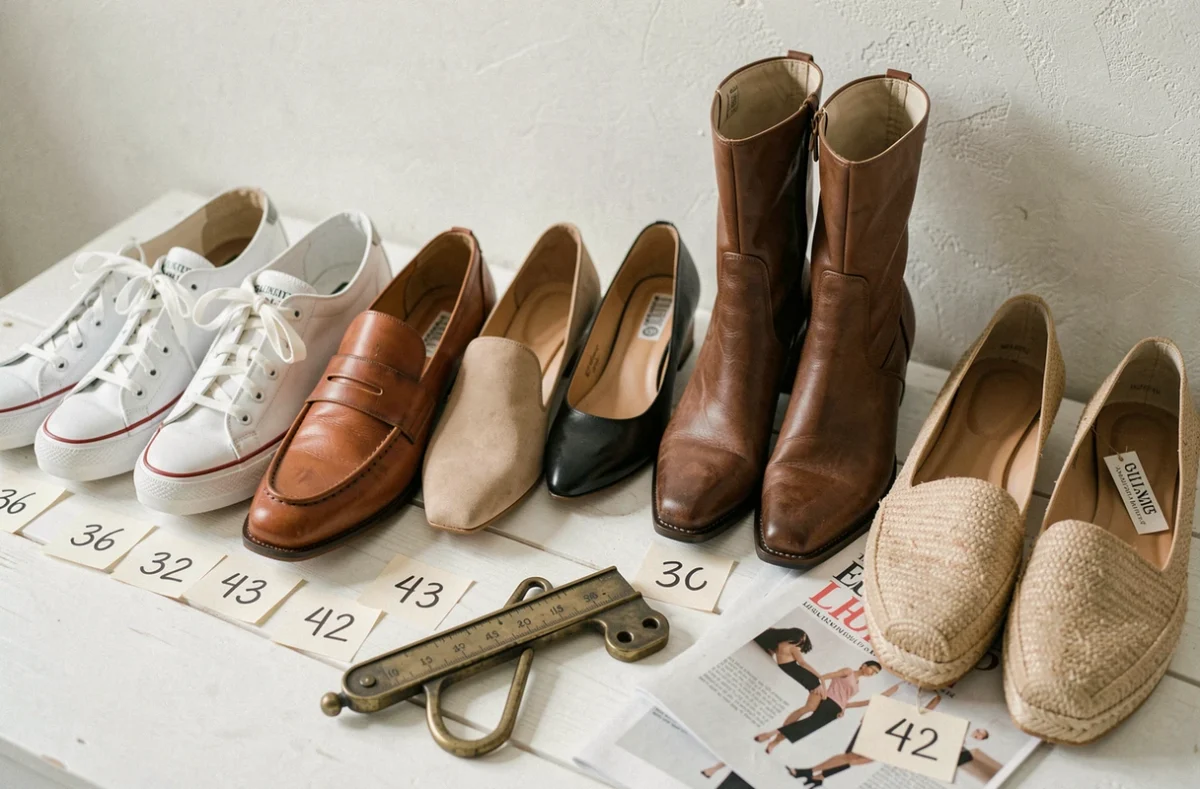
Size alone is an imperfect indicator. The width and volume of the foot can shift a purchase to a larger size. A foot measuring 27 cm long but wide will not fit comfortably into a standard size 42, and its owner will buy a size 43 or even 44 depending on the brands.
Specialized guides emphasize this point: two people with the same foot length can wear different sizes. The French system (Paris point), which is based on a calculation related to foot length in centimeters, does not take width into account. Some brands offer narrow, standard, or wide fittings, but this information is absent from most public conversion charts.
Consequences on sales interpretation
This parameter has a direct impact on the interpretation of the best-selling sizes. If a significant portion of buyers takes a half size or a size up to compensate for a fitting that is too narrow, sales shift towards the upper end of the curve without any real change in the average foot morphology.
The available data do not allow for precise quantification of this phenomenon. Field feedback varies on this point depending on segments (dress shoes, sneakers, hiking shoes) and brands, whose shapes vary considerably.
Best-selling sizes in France: what can be affirmed and what remains unclear
Size 42 for men and size 38 for women remain the reference sizes in French commercial assortments. Their dominance in stock grids is consistent with market feedback. Claiming that these are the “most popular sizes” in the strict statistical sense would require aggregated sales data, broken down by channel and segment, which no one publishes today.
- Size 42 for men and size 38 for women dominate assortments, but no public source provides a verifiable national ranking
- The confusion between catalog availability and sales volume skews the perception of actual demand
- The width of the foot, ignored by the French sizing system, shifts some purchases to larger sizes
- The growth of large women’s sizes remains poorly captured by classic panels
The next time an article claims that “the best-selling size in France is 42,” the appropriate reaction will be to check where the figure comes from. In most cases, it is an average stock figure, not a measure of demand.