
500 applications for 30 spots, and the question isn’t even about who has already shone under the spotlight. In France, most sports academies welcome young people without requiring a record of achievements, but the selection process often proves to be more demanding than in many professional centers. Families sometimes spend high fees, but the pressure is elsewhere: each season, one must stand out in a game where competition never takes a break.
From the outside, all academies promise the best. However, the gaps quickly widen: uneven educational support, facilities ranging from basic to ultra-modern, partnerships that are more or less solid with professional clubs… Settling for a reputable name exposes one to unexpected setbacks on the sports path. Behind the brochures and speeches, one must closely examine what really awaits young athletes.
How can you recognize a football academy that truly makes a difference for your child?
Properly training a young footballer is not just about accumulating victories. A serious academy builds a balance: progressing technically, succeeding academically, and staying healthy. This trio—sharp training, academic support, and medical supervision—forms the foundation for sustainable progress. On the field, this translates into individualized sessions, precise video analyses, and coaches who know how to go beyond just blowing the whistle.
To avoid mistakes, certain benchmarks deserve attention. Here are the criteria that make a difference:
- The success rate for the baccalaureate among boarding students
- The ability of young players to climb the ranks in national competitions
- The actual offer of internships or immersions with professional clubs
- The attention given to psychological support and injury prevention
Before making a choice, it’s better to look under the hood: a clear internal regulation, a well-defined educational project, coherent schedules. Parents who take the time to talk with former students, check the stability of the staff, and look into structures like sport-academy.fr gain a head start. A comprehensive educational project is never limited to the field.
A football academy is not judged by its trophies. What matters is the ability to support each young person, to help them assert themselves within a team, and to open them up to perspectives beyond the green rectangle. Football is also about learning to get back up, to accept setbacks, and to build one’s path with rigor and respect. True successes are written far from the spotlight, in consistency and preparation for adult life.
Overview of the best academies in France: benchmarks, specifics, and strengths to know
Football training centers that set the standard
For decades, France has established itself in the training of young athletes. Football training centers have become references, shaping new generations each year ready to face the demands of high-level competition. This success is based on fundamentals: sports discipline, innovative methods, immersion in an environment where competition is daily life.
To better navigate, here are the main types of centers and what distinguishes them:
- Club training centers: they offer a direct pathway to professional teams. Young players benefit from high-end facilities and proximity to crucial matches.
- Football training in France: the network of centers across the territory allows everyone to follow a tailored path that combines regular training, serious medical follow-up, and academic support.
In the most renowned academies, detection starts early. The focus is on individual progression, the balance between sports ambitions and academic success, and increasingly, the possibility of opening horizons internationally. Today, a forward-looking academy encourages mobility and exchanges to enrich the experience of the young footballer.
Some centers opt for small groups to ensure close monitoring. Others focus on technical specialization and strengthened collaborations with professional clubs, which serve as real springboards to access high-level competition. Their strength? Knowing how to combine rigor in training, team cohesion, and support towards a maturity essential in French football.
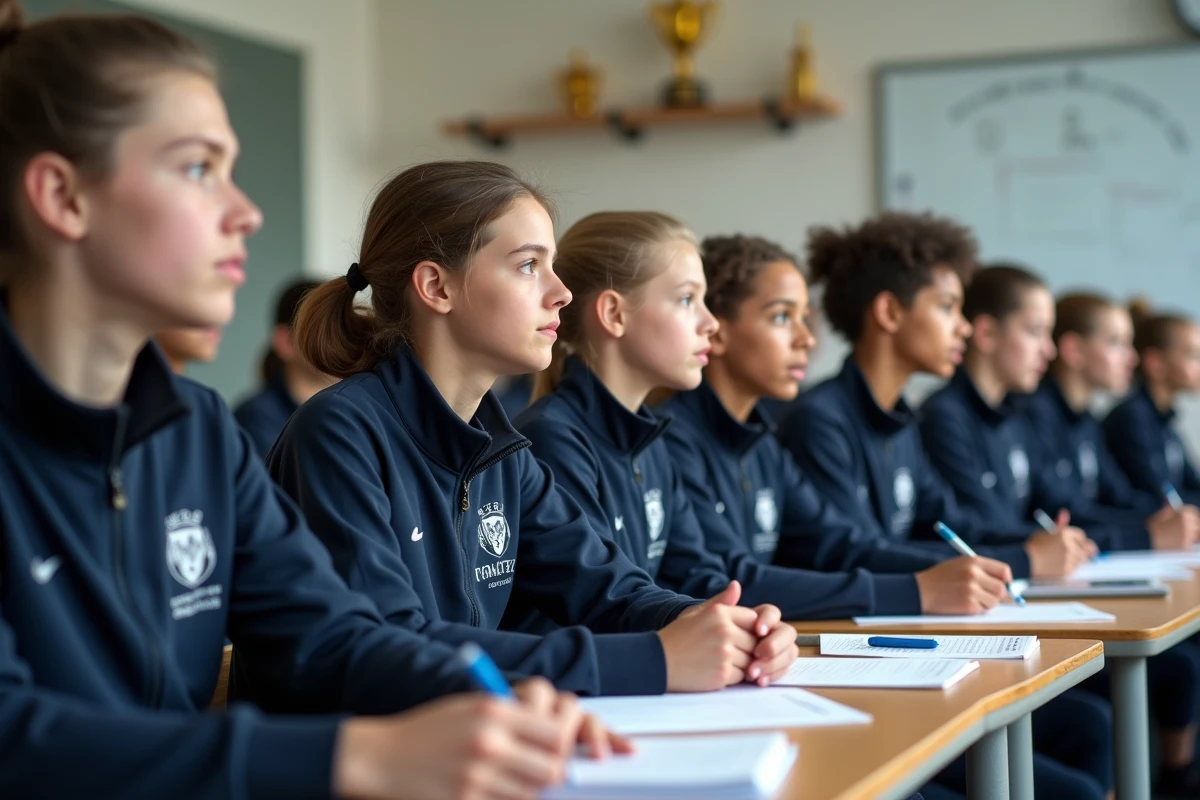
How much does it cost, how does it work: everything you need to know before enrolling your child
Enrolling a young person in a sports academy is never a trivial choice. It is embarking on a demanding journey where every detail makes a difference. Registration fees vary widely: depending on the prestige of the institution, the quality of supervision, and the facilities offered, one should expect to pay between 6,000 and 15,000 euros per year for a recognized structure. This budget covers schooling, accommodation, meals, and access to facilities designed to meet the needs of an aspiring athlete.
On a daily basis, the pace is intense. The student divides their time between intensive training, academic courses, and medical support. The educational team ensures a balance between sports ambition and academic success. Families benefit from individualized support, regular assessments, and ongoing dialogue with coaches.
Access to these academies generally depends on a selection process: application, physical tests, motivation interview. Admitted young people integrate into a stimulating collective, where mutual support and team spirit are essential. Depending on the situation, it is sometimes possible to obtain a payment plan or a scholarship. What underpins the entire system is an educational vision that places the young person’s development at the center of the approach.
Choosing an academy is much more than checking a box on a CV. It is betting on an environment that, day after day, shapes athletes but also citizens. On the journey, every step counts. Each person must chart their path, ball at their feet and head held high.