What trends are truly redefining men’s daily life in 2026? Between the search figures published by Pinterest in its Men’s Trend Report 2026, the new European regulatory constraints on environmental claims, and a wardrobe undergoing significant changes, current men’s trends paint a picture quite distant from simple product selections.
Men’s Trends 2026: The Fastest Growing Searches
Pinterest’s Men’s Trend Report 2026, published on September 9, 2026, provides actionable search data. It allows us to measure what truly engages men, beyond editorial intuition.
| Pinterest Search | Year-over-Year Growth | Category |
|---|---|---|
| Running club | +749 % | Team sports |
| No phone (ideas) | +581 % | Screen-free leisure |
| Offline hobbies | +551 % | Screen-free leisure |
| Workwear outfit (men) | +314 % | Wardrobe |
| Fragrance wardrobe | +159 % | Grooming |
| Sunscreen for men | +108 % | Grooming |
Two categories dominate: screen-free activities and daily personal care. The wardrobe is also evolving, but with a clear lag compared to the first two.
These figures reflect a deep-seated movement. To follow the news on Monsieur Magazine, these weak signals deserve attention.
Men’s Grooming: Daily Routine Replaces Occasional Care
The Pinterest report identifies a trend called “Quiet Upkeep.” The term describes a regular, structured maintenance routine, far from the occasional care before an event. It consists of six steps: cleansing, moisturizing, sun protection, fragrance, nails, and hairstyling.
The +108 % increase in searches for “sunscreen for men” illustrates this shift. Sun protection, long perceived as a beach product, is becoming a daily gesture integrated into facial care.
Fragrance follows a similar trajectory. Searches around the concept of “fragrance wardrobe” have surged by 159 %, signaling a more thoughtful use: several fragrances suited to different contexts rather than a single bottle. Men’s grooming is now organized like a parallel wardrobe.
However, this rise in grooming is accompanied by stricter regulations. The European directive 2024/825 now regulates environmental claims on cosmetic products. Terms like “eco-friendly,” “sustainable,” or “green” can no longer appear on packaging without verifiable proof. For men’s grooming brands that relied on these arguments, the constraint is real.
Screen-free Activities and Team Sports: What the Numbers Reveal
The most spectacular increases in the report do not concern clothing or accessories. They focus on screen-free leisure and group sports.
- Searches for “running club” have increased by 749 %, indicating that running is increasingly practiced collectively, with a social ritual around the effort.
- Searches for “offline hobbies” (+551 %) cover a broad spectrum: woodworking, cooking, bookbinding, film photography, all manual practices that require putting down the phone.
- Queries for “no phone” (+581 %) reflect an intentional approach to disconnection, not just a passing curiosity.
These data point to a phenomenon that transcends fashion. The man searching for “running club” does not just want to run: he seeks a collective framework, a regular meeting, a physical anchor in the week.
In contrast, searches related to connected tech accessories (watches, earbuds, gadgets) do not feature among the notable increases in the report. The gap is clear.
Men’s Wardrobe 2026: Workwear, Color, and Accessories on the Rise

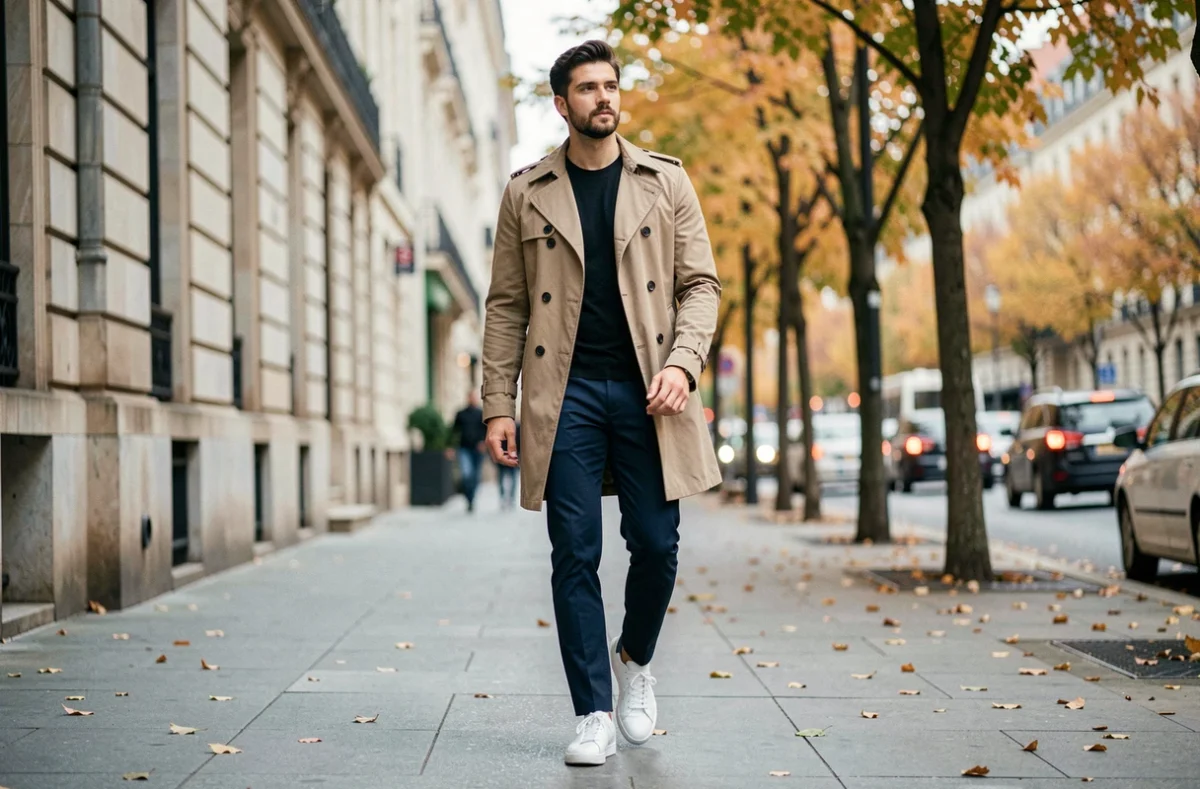
The clothing aspect of the Pinterest 2026 report confirms several simultaneous movements. Workwear is up by 314 %, and accessories (bags, jewelry, belts) are gaining visibility in searches.
Workwear in 2026 is no longer a raw uniform but an intentional wardrobe. Utility pieces (pocket jackets, cargo pants, chunky-soled boots) are combined with more polished elements. The search focuses on complete outfits, not isolated pieces.
The introduction of bright colors marks a break from the neutral palettes that have dominated men’s trends for several years. Brands offering colorful pieces in classic cuts are capturing this demand.
On the accessories side, men’s bags and subtle jewelry are on the rise. The men’s wardrobe is enriched with additional layers: a bag carried by hand, a ring, a fine chain. These elements, once marginal in men’s fashion, are becoming full-fledged style criteria.
Environmental Claims: Regulation Changing the Game for Men’s Brands
The European directive 2024/825, transposed in France, prohibits generic environmental claims without justification. In practical terms, a textile or cosmetic product can no longer display “eco-responsible” or “environmentally friendly” without providing documented and verifiable evidence.
This constraint directly affects fashion and men’s grooming brands that had built their positioning on vague promises. Labels will need to change, as will sales arguments.
For consumers, the consequence is twofold. Products genuinely engaged in measurable initiatives will gain clarity. Brands that practiced greenwashing will either need to invest in certifications or abandon these arguments.
The men’s trends of 2026 are not just about a wardrobe or a list of products. Pinterest data shows a shift towards structured daily care, collective screen-free practices, and a more colorful and intentional wardrobe. The European regulation on environmental claims adds an additional filter: brands targeting men will need to prove what they claim.