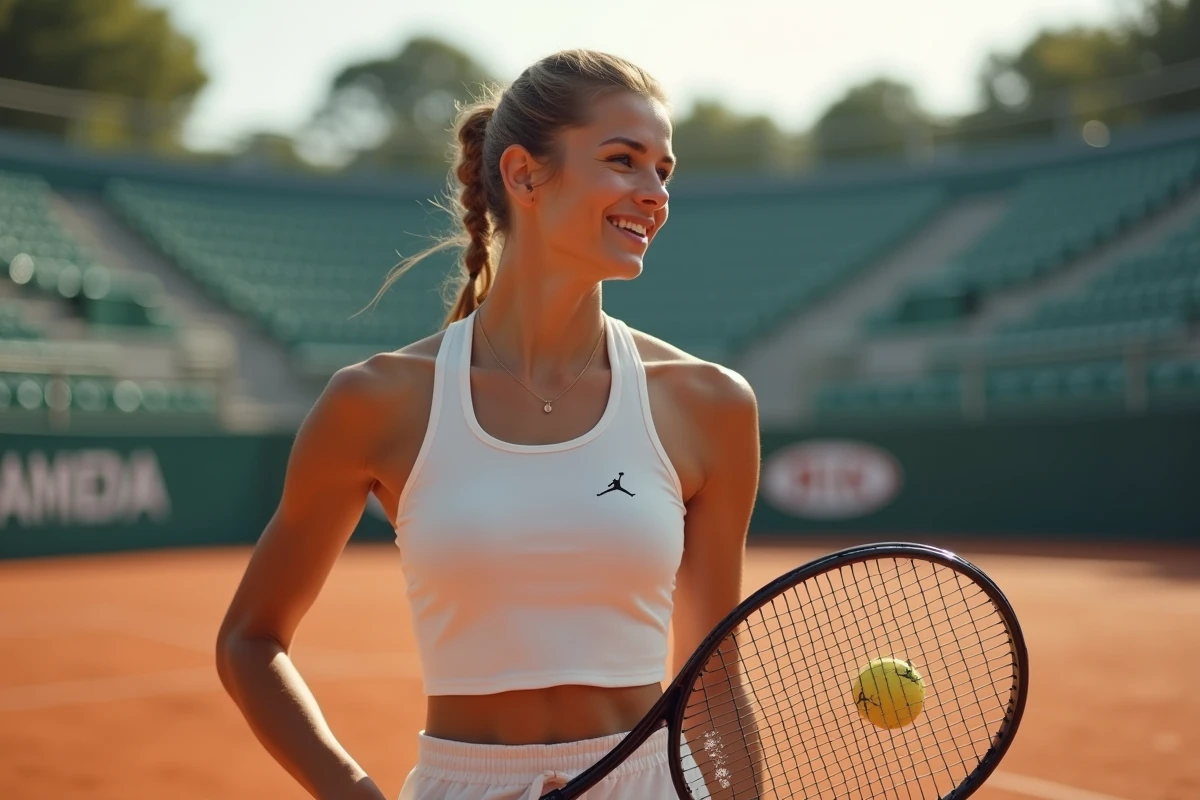
Aryna Sabalenka, the world number one in the WTA rankings, posted a series of photos on her Instagram account from a photoshoot in Minsk. Several shots show her posing topless in an artistic setting. The post generated tens of thousands of reactions and reignited a recurring debate in women’s tennis: the boundary between personal image and sports image.
Sabalenka’s Photoshoot in Minsk: What the Images Really Show
The photos shared on Instagram are not a scandal or a leak. They are a professional shoot, embraced and published by the player herself on her own account. The images fall within a controlled aesthetic, with lighting and staging that distance them from the provocative register that some media outlets have tried to assign to them.
The Facebook group Women’s Tennis Fans shared the images as soon as they were published, and Daily Mail Sport released a video compiling fans’ reactions, with many saying they were “stunned.” This media treatment contributed to amplifying a buzz that originally rested on content that is perfectly classic in the realm of professional sports.
When analyzing the topless shots of Aryna Sabalenka in their publication context, it is clear that the player controls every step of her visual communication, from the choice of photographer to the caption accompanying the post.

Sexualization in Women’s Tennis: Sabalenka’s Discourse Facing the Media
The reaction to the photoshoot cannot be understood without considering the position Aryna Sabalenka has publicly held for several seasons. In an interview with The Athletic in January 2024, around the Australian Open, she explained that she understood her physique attracted attention, but she primarily wanted to be judged on her tennis.
This statement sheds light on the approach behind the photoshoot. The player does not suffer from the emphasis on her body: she controls it. The nuance is significant, and articles that merely relay the buzz miss this point.
The WTA, through its “For The Game” campaign updated in 2024, promotes the visibility of female players and the growth of the audience for women’s tennis. The organizers of Grand Slam tournaments (Roland-Garros, Wimbledon) have made no public comment on the photoshoot. This institutional silence confirms that this type of content is perceived as belonging to the player’s private and marketing sphere, without interference with her sports career.
Reaction from Sponsors Nike and Wilson After the Publication
A topless photoshoot published by an athlete under contract with global brands raises a legitimate question: did the sponsors react? The answer is clear. No partnership has been terminated or modified following the release of the images.
Sabalenka’s agreements with Nike (equipment supplier) and Wilson (rackets) remain active and renewed for the 2024-2025 season, as confirmed by public documents from these brands (Nike, “Global Tennis Roster 2024”; Wilson, “Tennis Pros 2024”). No statement from either company mentions the photos.
This non-event from the sponsors’ side deserves attention. It signals a change in how sports brands manage the image of their female athletes:
- The publication of personal content of an artistic or fashion nature is no longer seen as a reputational risk by major equipment suppliers.
- Female athletes now have comparable latitude to their male counterparts in managing their image outside the courts.
- The continuation of contracts indicates that the photoshoot is perceived as compatible with the image strategy of Nike and Wilson, even beneficial in terms of visibility.

Buzz on Social Media: The Mechanism of Virality Surrounding a Tennis Player
The virality of the images relies on a well-identified mechanism. Content published by a top athlete, in an unexpected register compared to her main activity, generates a perceptual gap that encourages sharing.
Instagram serves here as the primary platform: Sabalenka controls the publication, the caption, the framing. Secondary platforms (Facebook, online sports media like Sports.fr or Daily Mail) amplify the content by adding an editorial layer that is often more sensationalist than the original.
The title from Sports.fr, “Aryna Sabalenka, the topless that sparks reactions,” illustrates this mechanism: the word “topless” grabs attention, and the verb “sparks reactions” promises controversy. The actual content of the article remains factual, but the title shapes perception long before reading.
What the Buzz Reveals About the Audience for Women’s Tennis
The “WTA For The Game” campaign is based on the growth of the audience for the women’s circuit. The fact that a personal photoshoot of a player generates as much traffic as some sports results shows that public interest extends beyond the strict confines of matches. Top-ranked players have become full-fledged media figures, whose reach extends far beyond the court.
Sabalenka understands this and uses the attention to her advantage. Publishing polarizing content on her own account, without media intermediaries, allows her to capture engagement without relinquishing editorial control. The media picks up, comments, but the source remains the player.
The Minsk photoshoot did not provoke any sporting sanctions, contract terminations, or institutional statements. The only measurable consequence remains the increase in Sabalenka’s visibility on social media, in a context where each additional engagement point enhances her commercial value with her partners.